The Complete Guide to Answer Engine Optimization and the Rise of AEO Checker Tools

The fundamental architecture of the internet is undergoing a structural shift. For decades, the digital economy was built upon the “ten blue links” model, where search engines acted as gateways, funneling traffic to external websites. Today, that model is being superseded by generative AI, where platforms like ChatGPT, Perplexity, and Google’s AI Overviews provide synthesized, comprehensive answers directly to the user. This evolution has birthed a new discipline: Answer Engine Optimization (AEO). As visibility that was once secured through traditional search engine rankings increasingly vanishes into AI-generated responses, businesses are turning to AEO checkers to maintain their digital presence and brand authority.
The Emergence of the Answer Engine Era
The shift toward generative search reached a critical inflection point in May 2024, when Google launched AI Overviews (AIO) for its general user base. This deployment marked the transition from search engines as navigational tools to answer engines as knowledge curators. Unlike traditional search, which presents a list of potential sources, an answer engine reads, interprets, and summarizes data from multiple sources to provide a singular, authoritative response.
![AEO checker tools that measure answer engine visibility [2026]](https://53.fs1.hubspotusercontent-na1.net/hubfs/53/aeo-checker-1-20260903-3858273.webp)
This creates a "zero-click" environment where the user’s intent is satisfied within the platform, negating the need to click through to a brand’s website. Consequently, businesses that fail to secure a citation or a brand mention within these AI summaries face a significant decline in organic traffic and brand awareness. The challenge for modern marketing teams is no longer just ranking on a page of results, but rather influencing the underlying intelligence that powers these generative responses.
Understanding Answer Engine Optimization
AEO is the strategic practice of ensuring that a brand is accurately represented, cited, and recommended within the responses provided by generative AI models. While Search Engine Optimization (SEO) remains vital for establishing the crawlability and domain authority that these AI models rely on, AEO focuses on the “answer-first” user experience.
The symbiotic relationship between SEO and AEO is clear: an AI engine requires high-quality, structured data to formulate a response. If a website lacks the technical SEO foundation—such as clear schema markup, direct answers to common queries, and verifiable primary sources—the generative engine is unlikely to trust or cite that content. Therefore, AEO does not replace SEO; it builds upon it by optimizing the information architecture to be easily parsed and synthesized by large language models (LLMs).
![AEO checker tools that measure answer engine visibility [2026]](https://no-cache.hubspot.com/cta/default/53/9dd5e54b-fbef-4dd0-bc44-1689feb1ea18.png)
The Role of AEO Checkers in Modern Marketing
As manual tracking becomes increasingly untenable due to the volatile and personalized nature of AI responses, the demand for dedicated AEO checking software has grown. An AEO checker is a diagnostic tool designed to monitor how a brand appears across various generative platforms.
Effective AEO tools perform three primary functions:
- Measurement: They track whether a brand is cited, mentioned, or ignored in responses to industry-specific queries.
- Diagnosis: They identify content gaps, such as when a competitor is cited for a query for which the brand is equally qualified.
- Prioritization: They provide actionable insights, flagging specific schema corrections, content updates, or entity-based improvements that will most likely lead to increased citations.
A Chronology of Search Evolution
The trajectory of search technology has accelerated rapidly over the last three years:
![AEO checker tools that measure answer engine visibility [2026]](https://53.fs1.hubspotusercontent-na1.net/hubfs/53/aeo-checker-2-20260903-852936.webp)
- Late 2022: The public release of ChatGPT demonstrates the potential for natural language responses, triggering a global shift in consumer expectations regarding how information is retrieved.
- May 2024: Google formally integrates AI Overviews into its search results, fundamentally changing the landscape for organic traffic and forcing a re-evaluation of legacy SEO strategies.
- June 2026: Google introduces dedicated generative AI performance reports, acknowledging that traditional search metrics are insufficient for measuring visibility in the AI era.
- Present Day: The market for AEO tools matures, with platforms like HubSpot, Ahrefs, and Semrush integrating AI-specific tracking features to bridge the gap between traditional search analytics and generative engine insights.
Manual vs. Automated Detection
For organizations just beginning their journey into AEO, manual checks are a common starting point. This involves defining a list of high-value, informational queries and executing them in incognito or signed-out browser sessions to avoid personalization bias. However, this method is fundamentally limited by the "black box" nature of AI. Because LLMs may generate different responses based on time, location, and the specific prompt architecture, a single manual check is often statistically insignificant.
Automated AEO checkers resolve this by running continuous, longitudinal tests. By monitoring queries at scale and across multiple engines simultaneously, these tools provide a trend line rather than a snapshot. This is critical because visibility in an AI response is rarely binary; it is a fluid metric that requires consistent optimization.
Evaluating the Competitive Landscape
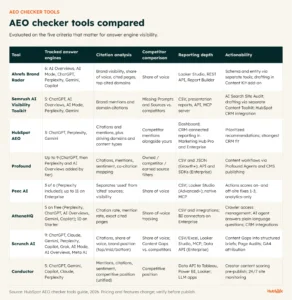
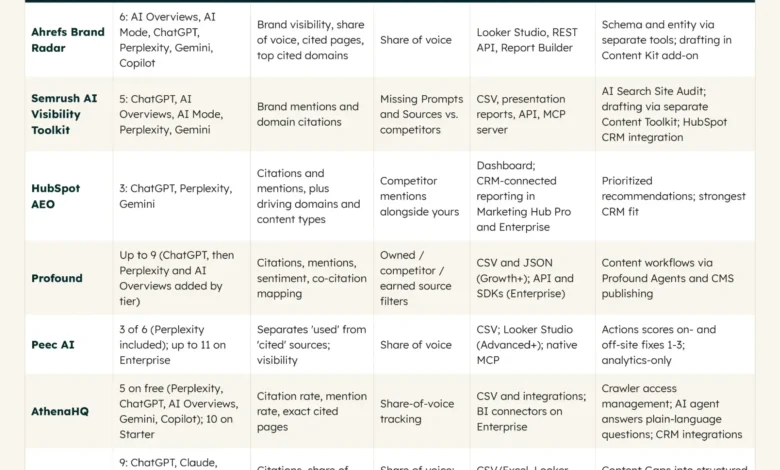
The market for AEO software is currently segmented based on the specific capabilities of the tools. For instance, tools like Ahrefs Brand Radar leverage real-time search queries to track AIO visibility, making them highly effective for those focused on Google’s ecosystem. Conversely, Profound offers deep-dive analytics, including sentiment scoring and a granular breakdown of citations by source type, which is invaluable for reputation management.
![AEO checker tools that measure answer engine visibility [2026]](https://53.fs1.hubspotusercontent-na1.net/hubfs/53/aeo-checker-3-20260903-8904553.webp)
For businesses integrated into the HubSpot ecosystem, HubSpot AEO offers a streamlined approach by connecting visibility data directly to CRM insights. This allows marketing teams to not only see where they are being cited but to understand how that visibility correlates with actual lead generation and deal velocity. Meanwhile, dedicated platforms like Peec AI and AthenaHQ offer specialized monitoring for Perplexity, which has gained significant traction among power users looking for high-accuracy, source-backed responses.
Data-Driven Metrics for the AI Era
Measuring success in the AEO landscape requires moving beyond standard click-through rates. Key performance indicators (KPIs) now include:
- Citation Coverage: The percentage of industry-related queries where the brand is explicitly cited.
- Mention Frequency: How often the brand is named within an answer, even without a direct link.
- Competitor Gap Analysis: Tracking the frequency with which competitors are cited for the same queries where the brand is absent.
- AI-Referred Traffic: Utilizing advanced CRM tracking to attribute website sessions to AI-generated sources, effectively quantifying the "zero-click" influence.
Implications for Future Strategy
The rise of answer engines presents both a threat and an opportunity. The threat is a potential loss of traffic control; the opportunity is the ability to become the definitive authority in a user’s decision-making process. By shifting focus toward the "answer" rather than the "link," businesses can align their content strategy with the reality of how modern consumers conduct research.
![AEO checker tools that measure answer engine visibility [2026]](https://53.fs1.hubspotusercontent-na1.net/hubfs/53/aeo-checker-4-20260903-6212698.webp)
The transition to AEO is not a temporary trend but a permanent adaptation to the democratization of intelligence. As LLMs become more integrated into the daily workflow of the global workforce, the brands that master the art of being "the answer" will likely command the greatest share of attention. Organizations that invest in robust AEO tools today are positioning themselves to lead in a future where the most valuable real estate on the internet is no longer a search ranking, but the content inside the AI’s response itself.
While the technology continues to evolve, the core requirement remains constant: delivering clear, authoritative, and structured information that serves the user’s intent. Whether through manual auditing or sophisticated, CRM-integrated software, the ability to monitor and influence this new digital frontier is now an essential component of any successful marketing strategy.